Simplified 2026 US Social Security Number Application: A 3-Step Process for New Arrivals

Simplified 2026 US Social Security Number Application: A 3-Step Process for New Arrivals
Welcome to the United States! As a new arrival, one of the most crucial steps you’ll take to establish your life here is obtaining a Social Security Number (SSN). The SSN is more than just a nine-digit number; it’s your key to employment, banking, housing, and countless other essential services. Navigating the application process can seem daunting, especially with evolving regulations. This comprehensive guide, focusing on the SSN Application 2026, is designed to simplify the journey for new arrivals, breaking it down into an easy-to-follow, three-step process.
Understanding the importance of the SSN is the first step. It’s used by the Social Security Administration (SSA) to track your earnings over a lifetime and to determine your eligibility for Social Security benefits. For employers, it’s necessary for reporting your wages to the government. For you, it’s vital for filing taxes, opening a bank account, applying for a driver’s license, renting an apartment, and even getting a cell phone contract. Without an SSN, many aspects of daily life in the U.S. become significantly more challenging.
While the core process for the SSN Application 2026 remains largely consistent, it’s always wise to be aware of any potential updates or changes in documentation requirements. This guide will provide you with the most current and relevant information to ensure a smooth and successful application. We’ll cover who is eligible, what documents you’ll need, and the exact steps to follow to get your Social Security card.
Step 1: Determine Your Eligibility for the SSN Application 2026
Before you even begin gathering documents, it’s essential to confirm your eligibility for an SSN. Not everyone in the U.S. is eligible, and the requirements primarily depend on your immigration status and your intent to work. The Social Security Administration (SSA) issues SSNs to U.S. citizens and certain non-citizens authorized to work in the U.S. If you are a new arrival, this usually means you have a specific visa status that permits employment.
Who Is Eligible?
- U.S. Citizens and Lawful Permanent Residents (Green Card Holders): If you are a U.S. citizen or have a Green Card, you are eligible for an SSN.
- Non-Citizens Authorized to Work: This category includes individuals with valid work visas such as H-1B, L-1, F-1 (with specific employment authorization like OPT/CPT), J-1 (with specific employment authorization), and various other employment-based visas. Your visa and I-94 record will indicate your authorization to work.
- Non-Citizens NOT Authorized to Work (Limited Eligibility): In very specific circumstances, non-citizens not authorized to work may be eligible for an SSN if a federal law requires them to have an SSN to receive a federally-funded benefit. However, for most new arrivals, the primary reason for obtaining an SSN is for employment purposes.
If you are a student on an F-1 or J-1 visa, you must typically have a job offer or be authorized for Optional Practical Training (OPT) or Curricular Practical Training (CPT) before you can apply for an SSN. Your Designated School Official (DSO) or Responsible Officer (RO) will need to provide you with a letter confirming your employment or work authorization.
Key Considerations for New Arrivals:
- Wait Period After Entry: Generally, if you applied for your SSN as part of your immigration visa application at a U.S. embassy or consulate abroad, you should typically wait at least 10 days after your arrival in the U.S. before contacting the SSA. This allows time for your immigration records to be updated in the Department of Homeland Security’s (DHS) systems.
- Proof of Work Authorization: For non-citizens, your eligibility hinges on your legal authorization to work in the U.S. This will be demonstrated through your visa, I-94 record, and, in some cases, an Employment Authorization Document (EAD) or a letter from your employer/school.
Confirming your eligibility is a critical first step for the SSN Application 2026. If you are unsure about your status or need clarification, it is always best to consult with your immigration attorney, international student advisor, or the Social Security Administration directly.
Step 2: Gather Your Essential Documents for the SSN Application 2026
Once you’ve confirmed your eligibility, the next crucial step is to gather all the necessary documents. The SSA requires specific original documents or certified copies to prove your identity, age, and U.S. immigration status/work authorization. Photocopies are generally not accepted. It’s imperative to have everything in order before visiting an SSA office to avoid delays.
Required Documents for New Arrivals:
1. Proof of Age:
You must provide a document showing your date of birth. Common acceptable documents include:
- U.S. birth certificate
- Foreign birth certificate
- Religious record showing age
- Passport (U.S. or foreign)
- U.S. hospital record of birth
For most new arrivals, your foreign passport will serve as proof of age.
2. Proof of Identity:
You must provide a document showing your identity. The document must be current (not expired) and show your name, identifying information (such as date of birth or age), and preferably a recent photograph. Acceptable documents include:
- U.S. driver’s license
- State-issued non-driver identification card
- U.S. passport
- Foreign passport
- Employee ID card
- School ID card
- Health insurance card (not Medicare)
- U.S. military ID card
For new arrivals, your foreign passport is typically used for proof of identity as well.
3. Proof of U.S. Immigration Status and Work Authorization:
This is arguably the most critical set of documents for non-citizens. You must provide documents showing your current immigration status and, if applicable, your authorization to work in the U.S. These documents should be original. Examples include:
- Form I-94, Arrival/Departure Record: This electronic record documents your legal entry into the U.S. You can usually access and print your I-94 record from the U.S. Customs and Border Protection (CBP) website. Ensure your I-94 accurately reflects your current immigration status and duration of stay.
- Foreign Passport with Visa: Your passport containing your U.S. visa stamp (if applicable) is essential.
- Form I-551, Permanent Resident Card (Green Card): If you are a lawful permanent resident.
- Form I-766, Employment Authorization Document (EAD or Work Permit): If you have one.
- Form I-20 (for F-1 students): You’ll also need a letter from your Designated School Official (DSO) confirming your employment and the nature of the employment.
- Form DS-2019 (for J-1 exchange visitors): Along with a letter from your Responsible Officer (RO) confirming your employment or program participation.
- Letter from your employer: If you are an F-1 or J-1 student, your employer may need to provide a letter detailing your job, start date, and employer contact information.
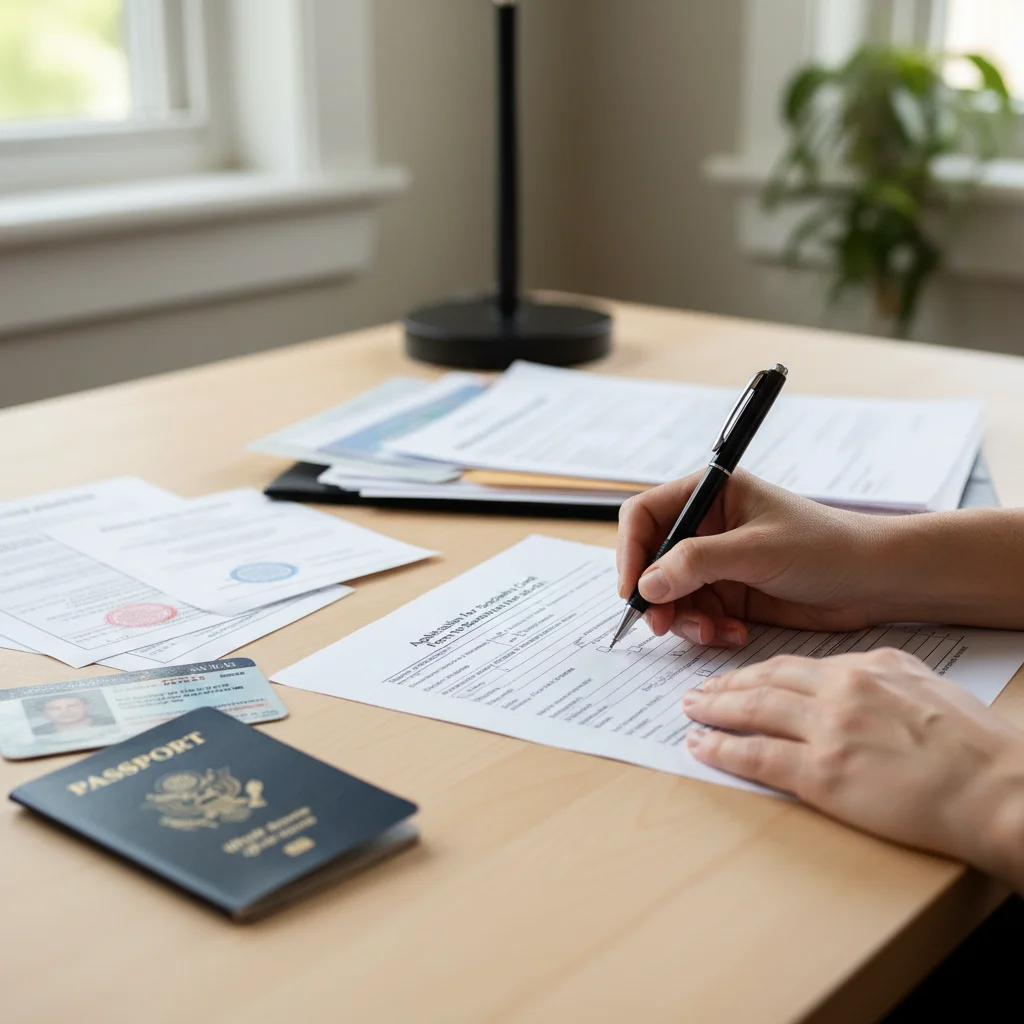
Important Tips for Document Gathering:
- Originals Only: The SSA requires original documents or copies certified by the issuing agency. Photocopies are generally not accepted.
- Check Expiration Dates: Ensure all your immigration and identity documents are current and not expired.
- Translations: If any of your documents are not in English, you must provide a certified English translation along with the original document.
- Keep Copies: Make photocopies of all your documents for your records before you submit the originals to the SSA. The SSA will return your original documents.
Having all your documents organized and verified before your visit will significantly streamline your SSN Application 2026 process.
Step 3: Complete the Application and Visit the SSA Office for Your SSN Application 2026
With your eligibility confirmed and all necessary documents in hand, you are ready for the final step: completing the application form and visiting your local Social Security Administration office. This step requires attention to detail and a bit of patience.
1. Complete Form SS-5, Application for a Social Security Card:
The primary form you will need to complete is Form SS-5, Application for a Social Security Card. This form is straightforward and asks for basic personal information, including your name, date of birth, place of birth, parents’ names, and contact information. You can download this form from the SSA website (www.ssa.gov/forms/ss-5.pdf) and fill it out electronically or print it and fill it out by hand. Make sure all information is accurate and matches your supporting documents.
2. Locate Your Nearest SSA Office:
You cannot apply for an SSN online or by phone. You must apply in person at a local Social Security Administration office. You can find the nearest office by using the SSA’s office locator tool on their website (www.ssa.gov/locator/). It’s advisable to check the office hours and any specific requirements or recommendations for visits (e.g., if appointments are encouraged or required).
3. Visit the SSA Office:
When you visit the SSA office, bring your completed Form SS-5 and all your original supporting documents. Be prepared for a wait, as SSA offices can be busy. During your appointment, an SSA representative will review your application and documents. They may ask you questions to clarify information or confirm details. Be polite, patient, and answer all questions truthfully.
What to Expect After Application:
- Document Return: The SSA representative will return your original documents to you after verifying them. They do not keep your originals.
- Processing Time: After you apply, the SSA will process your application. If all your documents are in order and your immigration records are verified by DHS, you should receive your Social Security card by mail within 2-4 weeks. In some cases, especially if there are issues with DHS record verification, it might take longer (up to several weeks or even months).
- SSN Verification: You can typically start working once you have your work authorization, even if you haven’t received your physical SSN card yet, as long as you have applied for it. Your employer can use a process to verify your application with the SSA. However, you will need to provide your SSN to your employer once you receive it.

Important Considerations for Your Visit:
- Timing: If you are a new arrival, remember the 10-day waiting period after entering the U.S. to ensure your immigration records are updated.
- Be Prepared: Have all your documents easily accessible and organized.
- Ask Questions: If you have any doubts or questions during the application process, don’t hesitate to ask the SSA representative for clarification.
Common Pitfalls and How to Avoid Them in Your SSN Application 2026
While the three-step process for the SSN Application 2026 is straightforward, certain issues can cause delays or complications. Being aware of these common pitfalls can help you avoid them.
1. Incomplete or Incorrect Application Form (SS-5):
Pitfall: Filling out Form SS-5 with missing information or errors, or information that doesn’t match your supporting documents.
Solution: Double-check every field on Form SS-5. Ensure your name, date of birth, and other personal details exactly match your passport and other immigration documents. If you make a mistake, it’s better to start with a fresh form than to have cross-outs and corrections that might raise questions.
2. Missing or Unacceptable Documents:
Pitfall: Arriving at the SSA office without all required original documents, or presenting photocopies when originals are needed.
Solution: Create a checklist of all required documents (proof of age, identity, immigration status, and work authorization) and verify you have every original item before leaving for the SSA office. Remember that the SSA does not accept notarized copies or photocopies unless they are certified by the issuing agency. Always bring the original documents.
3. Discrepancies in Immigration Records:
Pitfall: Your immigration records (e.g., I-94) in the DHS system have not been updated or contain errors, leading to delays in verification.
Solution: Allow at least 10 days after your U.S. entry before applying for your SSN. Before your SSA visit, check your I-94 record online at the CBP website to ensure all information is accurate and updated. If you find errors, contact CBP to correct them before applying for your SSN.
4. Applying Too Early (for F-1/J-1 Students):
Pitfall: F-1 or J-1 students applying for an SSN without a job offer or proper work authorization documentation (e.g., DSO/RO letter).
Solution: If you are an F-1 or J-1 student, ensure you have secured a job offer or have the necessary work authorization (like CPT or OPT) and have obtained the required letter from your DSO or RO before applying for your SSN. The SSA will verify your work authorization with your school.
5. Not Being Prepared for Questions:
Pitfall: Being unable to answer basic questions about your identity, immigration status, or reason for applying during your SSA interview.
Solution: Be ready to clearly articulate your purpose for applying for an SSN and provide details about your immigration status and work authorization. Having a clear understanding of your documents will help you answer confidently.
6. Incorrect Address for Mailing the Card:
Pitfall: Providing an incorrect or temporary mailing address, leading to your SSN card being lost in the mail.
Solution: Ensure the mailing address you provide on Form SS-5 is a stable, reliable address where you can receive mail for several weeks. If you anticipate moving, consider using a friend’s or trusted relative’s address, or a post office box if permissible by SSA policy (though typically a residential address is preferred). Always inform the SSA of any address changes immediately if your card has not yet arrived.
7. Applying for a Replacement Card Unnecessarily:
Pitfall: Applying for a replacement card if you lose your SSN but can remember the number. You typically only need the physical card for certain situations; knowing the number is often sufficient.
Solution: If you lose your card, first determine if you truly need a physical replacement. You are limited to 3 replacement cards per year and 10 in a lifetime. Your employer and financial institutions usually only need the number itself. If you do need a replacement, follow the same application process as a new card, providing proof of identity.
By being mindful of these potential issues, you can significantly increase the chances of a smooth and efficient SSN Application 2026 process, ensuring you receive your Social Security card without unnecessary delays.
The Importance of Your SSN Beyond the Application
Receiving your Social Security Number is a significant milestone for any new arrival in the U.S. It’s not just a formality; it’s a foundational element for integrating into American society and its economic system. Understanding its ongoing importance will help you manage it responsibly.
Building Credit History:
Your SSN is essential for building a credit history. When you open bank accounts, apply for credit cards, loans, or even utility services, your SSN is used to report your financial activities to credit bureaus. A good credit history is vital for future endeavors like buying a car, purchasing a home, or even securing certain types of employment.
Employment and Taxes:
Every employer in the U.S. will require your SSN for tax purposes. It allows them to report your wages to the Internal Revenue Service (IRS) and the Social Security Administration. Your SSN is also crucial for filing your annual income tax returns, ensuring you comply with federal and state tax laws.
Accessing Government Services and Benefits:
While primarily for work and taxation, your SSN is also used by various government agencies. It’s necessary for applying for federal benefits (if eligible), certain types of financial aid, and even some state-level services like a driver’s license or state ID. For instance, without an SSN, obtaining a driver’s license can be significantly more complicated, or even impossible in some states.
Identity Protection:
Because your SSN is so vital and unique to you, it’s a prime target for identity theft. It’s crucial to protect your SSN carefully. Do not carry your Social Security card in your wallet unless absolutely necessary. Memorize your number and keep the card in a safe, secure place. Be wary of sharing your SSN over the phone or online unless you are certain of the requestor’s legitimacy.
Long-Term Planning:
Your SSN is linked to your lifetime earnings record, which determines your eligibility for Social Security retirement, disability, and survivor benefits. The more you earn and contribute through Social Security taxes over your working life, the higher your potential future benefits will be. This long-term aspect underscores the importance of obtaining your SSN early and ensuring your earnings are correctly reported.
In essence, the SSN Application 2026 is just the beginning. The number you receive will be a constant companion throughout your life in the U.S., opening doors and facilitating your integration. Treat it with the importance it deserves, and you’ll navigate your new life with greater ease and security.
Conclusion: Your Smooth Path to an SSN in 2026
The journey to obtaining your Social Security Number as a new arrival in the U.S. is a fundamental step toward building your life in this country. By following this simplified, three-step guide for the SSN Application 2026, you can approach the process with confidence and clarity. Remember to first confirm your eligibility, meticulously gather all required original documents, and then complete Form SS-5 before visiting your local Social Security Administration office.
While the process demands attention to detail and patience, the reward is invaluable: a nine-digit number that unlocks opportunities for employment, financial stability, and access to essential services. Your SSN is not just a bureaucratic requirement; it is a cornerstone of your identity and participation in American society.
We encourage you to use this guide as a reliable resource, but also to always refer to the official Social Security Administration website (www.ssa.gov) for the most up-to-date information and any potential changes in policy or requirements. Staying informed is your best defense against delays and complications.
By taking these steps diligently, new arrivals can ensure a smooth and successful SSN Application 2026, paving the way for a productive and integrated experience in the United States. Welcome, and best of luck with your new beginnings!