AI’s Impact on US Careers: 4 Key Adaptations for 2026
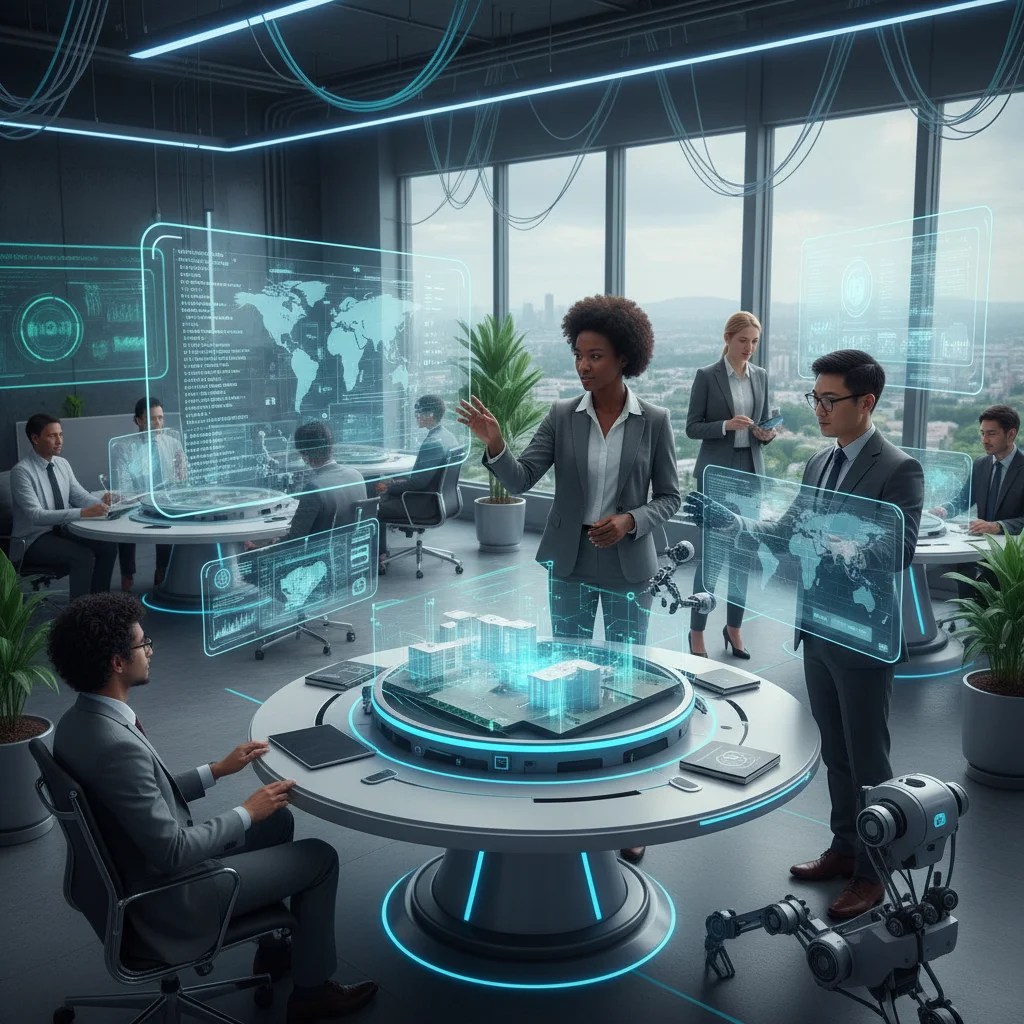
The landscape of work in the United States is undergoing a seismic shift, powered by the relentless march of artificial intelligence (AI). What was once the stuff of science fiction is now an everyday reality, influencing everything from customer service to complex data analysis. For professionals across all sectors, understanding and adapting to these changes isn’t just an advantage; it’s a necessity for survival and growth. This comprehensive guide delves into the profound impact of AI on US career trajectories and outlines four crucial adaptations that will define success for individuals and organizations by 2026 and beyond. The future isn’t just coming; it’s already here, and those who embrace AI career adaptations will be the ones to thrive.
AI’s integration into the workplace is not merely about automating repetitive tasks; it’s about fundamentally altering job roles, creating new industries, and demanding a different set of human skills. While fears of widespread job displacement often dominate headlines, a more nuanced perspective suggests that AI will augment human capabilities, leading to increased productivity and the creation of entirely new types of work. However, this optimistic outlook hinges on one critical factor: our collective ability to adapt. Professionals who proactively engage in AI career adaptations will be better positioned to navigate this evolving terrain.
The pace of AI development is accelerating. Technologies like machine learning, natural language processing, and computer vision are becoming more sophisticated and accessible, permeating every facet of business operations. From personalized marketing campaigns to predictive maintenance in manufacturing, AI is optimizing processes, generating insights, and making decisions at scales and speeds impossible for humans alone. This presents both challenges and unparalleled opportunities for the US workforce. Staying ahead means understanding these shifts and implementing effective AI career adaptations.
For individuals, the question is no longer "Will AI affect my job?" but rather "How will AI affect my job, and what must I do to prepare?" The answer lies in a strategic approach to skill development, a willingness to embrace new tools, and a deep understanding of where human intelligence complements artificial intelligence. Organizations, too, bear a responsibility to foster a culture of continuous learning and provide resources for their employees to make these essential AI career adaptations. The goal is not to compete with AI, but to collaborate with it, leveraging its power to achieve outcomes previously unimaginable.
The Current State of AI in the US Job Market
Before diving into the necessary adaptations, it’s vital to grasp the current footprint of AI in the US job market. AI is no longer confined to tech giants; it’s a pervasive force touching almost every industry. In manufacturing, AI-powered robotics are streamlining production lines, increasing efficiency, and improving safety. In healthcare, AI is assisting in diagnostics, drug discovery, and personalized treatment plans. Financial services utilize AI for fraud detection, algorithmic trading, and risk assessment. Even creative fields like marketing and content creation are seeing AI tools assist in generating ideas, optimizing campaigns, and analyzing consumer behavior.
Recent reports indicate a significant uptake in AI adoption across US businesses. A substantial percentage of companies are already using AI in some form, and this number is projected to grow exponentially. This widespread adoption is leading to a re-evaluation of job descriptions and skill requirements. Roles that involve repetitive, rule-based tasks are most susceptible to automation. However, this doesn’t necessarily mean job losses; often, it means a reallocation of human effort towards more complex, strategic, and creative endeavors. This necessitates a focus on AI career adaptations.
The demand for AI-related skills is skyrocketing. Data scientists, machine learning engineers, AI ethicists, and prompt engineers are among the most sought-after professionals. However, the impact extends beyond these specialized roles. Even traditional roles like project managers, customer service representatives, and HR professionals are finding that an understanding of AI tools and principles can significantly enhance their effectiveness. This emphasizes the broad relevance of AI career adaptations.
Furthermore, AI is creating entirely new job categories that didn’t exist a decade ago. The development, deployment, and maintenance of AI systems require a new ecosystem of talent. This dynamic environment underscores the urgency for both individuals and educational institutions to align their strategies with the demands of an AI-driven economy. The ability to make effective AI career adaptations will determine who thrives and who struggles in this new era.
Adaptation 1: Embrace Continuous Learning and Reskilling
The most fundamental adaptation for anyone navigating the AI-driven future is an unwavering commitment to continuous learning and reskilling. The traditional model of education—learn once, work for life—is obsolete. In an era where technological advancements can render skills outdated in a matter of years, lifelong learning becomes the bedrock of career resilience. This is the cornerstone of effective AI career adaptations.
The Imperative of Upskilling
Upskilling involves acquiring new, more advanced skills within your current field. For instance, a marketing professional might learn to use AI-powered analytics tools to segment audiences or optimize ad spend. A software developer might learn new AI frameworks or programming languages relevant to machine learning. This deepens expertise and allows professionals to leverage AI to perform their existing roles more effectively and strategically.
The Necessity of Reskilling
Reskilling, on the other hand, involves learning entirely new skills to transition into a different role or industry. As some tasks become automated, certain roles might diminish. Professionals in these areas will need to acquire new competencies to move into emerging roles that are either AI-resistant or AI-enhanced. For example, a data entry clerk might reskill to become a data analyst, focusing on interpreting AI-generated insights rather than manual input. This represents a significant aspect of AI career adaptations.
Key Areas for Learning
- AI Literacy: Understanding the basics of how AI works, its capabilities, and its limitations. This isn’t about becoming an AI engineer, but about being an informed user and collaborator.
- Data Fluency: Given that AI thrives on data, the ability to understand, interpret, and work with data will be crucial across all roles. This includes data visualization, basic statistical analysis, and data governance.
- New Tool Proficiency: Familiarize yourself with AI-powered tools relevant to your industry, whether it’s generative AI for content creation, AI for project management, or AI in design.
- Programming Basics: While not universally required, foundational knowledge in programming (e.g., Python) can open doors to more advanced roles and a deeper understanding of AI systems.
Online courses, certifications, bootcamps, and employer-sponsored training programs are invaluable resources for this continuous learning journey. Investing time and effort in these areas is investing in your future relevance. This proactive approach to AI career adaptations is non-negotiable.

Adaptation 2: Cultivate Uniquely Human Skills
While AI excels at processing information, recognizing patterns, and executing tasks, it still largely lacks the nuanced capabilities that define human intelligence. These "soft skills" or "human-centric skills" are becoming increasingly valuable in an AI-augmented workplace. This is where the true power of AI career adaptations lies.
Critical Thinking and Problem-Solving
AI can provide data and suggest solutions, but humans are still best equipped to critically evaluate those suggestions, identify underlying problems that AI might miss, and devise innovative approaches that require abstract reasoning and contextual understanding. The ability to ask the right questions, challenge assumptions, and think creatively about complex issues remains a distinctly human advantage.
Creativity and Innovation
While generative AI can produce creative outputs (text, images, music), true innovation often stems from human intuition, emotional intelligence, and the ability to connect disparate ideas in novel ways. AI can be a powerful tool for creative professionals, but it’s the human spark that drives groundbreaking ideas and artistic expression. Fostering this creativity is a vital AI career adaptation.
Emotional Intelligence and Empathy
Roles that require deep human connection, understanding emotions, resolving interpersonal conflicts, and building trust are inherently difficult for AI to replicate. Customer service, HR, sales, teaching, and healthcare all rely heavily on emotional intelligence. As AI handles more routine interactions, the demand for human professionals who can provide genuine empathy and personalized support will only grow.
Collaboration and Communication
Working effectively in teams, negotiating, influencing, and communicating complex ideas clearly and persuasively are skills that remain central to organizational success. As human-AI collaboration becomes the norm, the ability to effectively communicate with both humans and AI systems (e.g., through prompt engineering) will be paramount. These are essential AI career adaptations for a collaborative future.
Ethical Reasoning and Judgment
The deployment of AI raises significant ethical questions regarding bias, privacy, accountability, and societal impact. Humans are responsible for setting ethical guidelines, making moral judgments, and ensuring that AI is developed and used responsibly. This requires strong ethical reasoning and a commitment to human values, skills that AI cannot possess. Developing these skills is a critical AI career adaptation for leadership.
Focusing on these uniquely human attributes not only makes individuals more resilient to automation but also positions them as invaluable assets in an AI-powered world. These skills differentiate humans from machines and are central to making meaningful AI career adaptations.
Adaptation 3: Master Human-AI Collaboration
The most effective strategy for thriving in the AI era is not to compete with AI, but to collaborate with it. Human-AI collaboration involves understanding how to leverage AI tools to enhance one’s own capabilities, automate mundane tasks, and focus on higher-value activities. This strategic partnership is a cornerstone of successful AI career adaptations.
Understanding AI’s Strengths and Weaknesses
Successful collaboration begins with a clear understanding of what AI does best (e.g., pattern recognition, data processing, repetitive tasks) and where it falls short (e.g., common sense reasoning, emotional understanding, complex ethical decisions). By aligning tasks with the strengths of each partner, overall efficiency and effectiveness can be dramatically improved. This discernment is a key AI career adaptation.
Becoming a "Prompt Engineer" (Broadly Defined)
With the rise of generative AI, the ability to effectively "prompt" AI models to produce desired outputs is becoming a valuable skill. This isn’t just for technical roles; anyone using tools like ChatGPT or Midjourney benefits from understanding how to craft clear, specific, and iterative instructions. This concept extends to any interaction with AI, where precise input leads to better outcomes. Mastering this interaction is a crucial AI career adaptation.
Leveraging AI for Augmentation
Think of AI as a powerful assistant. For writers, AI can generate first drafts or brainstorm ideas. For designers, AI can create variations or optimize layouts. For analysts, AI can process vast datasets and highlight trends. By offloading the routine and data-intensive aspects of work to AI, professionals can free up their time to focus on strategic thinking, creative problem-solving, and interpersonal engagement. This augmentation is a primary goal of AI career adaptations.
Monitoring and Validating AI Outputs
AI is not infallible. It can produce biased results, hallucinate information, or make errors. Human oversight is crucial to validate AI outputs, correct inaccuracies, and ensure that the AI’s actions align with organizational goals and ethical standards. This requires a critical perspective and an understanding of the data and algorithms driving the AI. This critical oversight is an important AI career adaptation.
Developing the mindset and skills for effective human-AI collaboration will transform how work is done, leading to greater productivity, innovation, and job satisfaction. It’s about becoming a skilled "AI whisperer" or "AI conductor," orchestrating the capabilities of both human and artificial intelligence to achieve superior results. This is perhaps the most practical of all AI career adaptations.

Adaptation 4: Embrace Agility and Adaptability
The final, overarching adaptation is the cultivation of agility and adaptability. The technological landscape, particularly concerning AI, is not static; it’s constantly evolving. What is cutting-edge today may be commonplace tomorrow, and what is emerging today could be revolutionary next year. This continuous change necessitates a flexible mindset and the ability to pivot quickly, which are essential AI career adaptations.
A Growth Mindset
Individuals with a growth mindset believe their abilities and intelligence can be developed through dedication and hard work. This contrasts with a fixed mindset, which assumes these traits are static. In the context of AI, a growth mindset is crucial. It encourages individuals to view new challenges as opportunities for learning, rather than insurmountable obstacles. This psychological shift is a foundational AI career adaptation.
Comfort with Ambiguity and Change
The future of work is inherently uncertain. New technologies will emerge, job roles will transform, and industries will be disrupted. Professionals who can navigate ambiguity, embrace change, and remain resilient in the face of the unknown will be better positioned for success. This means being open to new ways of working, new tools, and new career paths. Agility in thought and action is a vital AI career adaptation.
Proactive Skill Acquisition
Rather than waiting for a skill gap to become critical, agile professionals proactively identify emerging trends and acquire relevant skills before they become mandatory. This involves staying informed about AI developments, networking with experts, and continuously assessing one’s own skill set against future demands. This forward-thinking approach is a hallmark of effective AI career adaptations.
Experimentation and Iteration
The AI landscape encourages an iterative approach. Experiment with new AI tools, test different ways of integrating AI into your workflow, and be prepared to learn from failures. This willingness to experiment, adapt based on feedback, and continuously refine one’s approach is a powerful form of adaptability. This hands-on experimentation is a practical AI career adaptation.
Organizations can foster agility by creating cultures that encourage experimentation, provide resources for learning, and celebrate adaptability. For individuals, it means actively seeking out new challenges, embracing discomfort, and understanding that learning is a continuous journey, not a destination. This overarching adaptability ensures that all other AI career adaptations remain relevant and effective.
The Future of Work: A Human-AI Partnership
As we look towards 2026 and beyond, the vision of the US job market is not one dominated by machines, but one characterized by a powerful human-AI partnership. AI will handle the data-intensive, repetitive, and optimizing tasks, while humans will focus on creativity, critical thinking, emotional intelligence, and strategic decision-making. This synergy promises to unlock unprecedented levels of productivity, innovation, and societal progress.
However, realizing this potential requires a collective effort. Educational institutions must reform curricula to emphasize AI literacy and human-centric skills. Businesses must invest in training and development programs, creating pathways for their workforce to adapt. And individuals must take personal responsibility for their continuous learning and skill development. Each of these components contributes to successful AI career adaptations.
The fear of AI replacing jobs is understandable, but a more accurate perspective is that AI will transform jobs. It will eliminate some tasks, create new ones, and fundamentally change the nature of many existing roles. Those who view AI as a tool for augmentation and a catalyst for personal growth will be the ones who not only survive but thrive in this new era. Embracing AI career adaptations is not just about job security; it’s about unlocking new potentials and shaping a more innovative and productive future.
The journey of AI career adaptations is ongoing. It demands vigilance, curiosity, and a proactive stance. By embracing continuous learning, cultivating uniquely human skills, mastering human-AI collaboration, and fostering agility, US professionals can confidently navigate the evolving job market, turning the challenges of AI into unparalleled opportunities for growth and success. The time to adapt is now, and the rewards for those who do will be substantial.