Roth IRA Contributions 2026: Limits, Backdoor Strategies & Planning

Welcome to the definitive guide on Roth IRA 2026 contributions, income limits, and advanced strategies. As we look ahead to 2026, understanding the nuances of Roth IRAs becomes increasingly crucial for effective retirement planning. A Roth IRA stands out as a powerful retirement savings vehicle due to its tax-free withdrawals in retirement, provided certain conditions are met. This unique feature makes it an attractive option for many, especially those who anticipate being in a higher tax bracket during their retirement years than they are today. However, navigating the rules, particularly the income limitations, can be complex. This comprehensive article will break down everything you need to know about Roth IRA contributions in 2026, including expected contribution limits, income thresholds, and the ever-popular backdoor Roth strategy.
The landscape of retirement planning is constantly evolving, with new rules and adjustments made by the IRS annually. Staying informed about these changes is key to maximizing your savings and ensuring compliance. Our focus here is to provide you with a clear, actionable understanding of the Roth IRA 2026 specifics, empowering you to make informed decisions for your financial future. We’ll delve into who is eligible, how much you can contribute, and perhaps most importantly, how to leverage strategies like the backdoor Roth IRA to overcome income restrictions.
Understanding the Roth IRA: Core Principles and Benefits for 2026
Before diving into the specifics of 2026, let’s revisit the fundamental principles that make a Roth IRA such a valuable asset. Unlike traditional IRAs, contributions to a Roth IRA are made with after-tax dollars. This means you don’t get an upfront tax deduction. However, the significant advantage comes at retirement: all qualified withdrawals, including both your contributions and earnings, are completely tax-free. This tax-free growth and withdrawal feature is a game-changer for long-term wealth accumulation.
For 2026, the appeal of the Roth IRA 2026 remains strong. As individuals progress in their careers and potentially move into higher tax brackets, the idea of tax-free income in retirement becomes even more enticing. Imagine a scenario where your investments have grown significantly over decades; being able to access that entire sum without owing a penny in taxes can dramatically enhance your financial security and lifestyle in retirement. Furthermore, Roth IRAs do not have required minimum distributions (RMDs) for the original owner during their lifetime, offering greater flexibility in managing your retirement income.
Another benefit often overlooked is the ability to withdraw contributions (but not earnings) tax-free and penalty-free at any time. This provides a level of liquidity that other retirement accounts may not offer, serving as an emergency fund of sorts, though it should ideally be reserved for retirement savings. Understanding these core benefits is the first step in appreciating why maximizing your Roth IRA 2026 contributions should be a priority for many.
Expected Roth IRA Contribution Limits for 2026
Each year, the IRS reviews and adjusts contribution limits for various retirement accounts, including the Roth IRA. While the official 2026 limits are typically announced later in the preceding year (e.g., late 2025), we can make educated projections based on historical trends and inflation adjustments. For 2025, the Roth IRA contribution limit for those under age 50 is expected to be around $7,000, and for those age 50 and over, it will likely be $8,000 (including the $1,000 catch-up contribution). Based on these figures, we anticipate slight increases for 2026, reflecting inflationary adjustments.
- Under Age 50: The standard contribution limit for the Roth IRA 2026 is projected to be in the range of $7,000 to $7,500. This limit applies to the total amount you can contribute to all your IRAs (traditional and Roth combined) for the year.
- Age 50 and Over: Individuals who are age 50 or older by the end of 2026 are eligible for an additional catch-up contribution. This catch-up amount is typically $1,000. Therefore, the total projected contribution limit for this age group could be between $8,000 and $8,500.
It’s crucial to remember that these are projections. Always consult the official IRS publications or a qualified financial advisor for the definitive 2026 contribution limits once they are released. Staying updated on these figures is vital for anyone planning to contribute to a Roth IRA 2026.
Navigating Roth IRA Income Limits for 2026
One of the most significant challenges for higher-income earners when it comes to Roth IRAs is the income limitation. The ability to contribute directly to a Roth IRA is phased out once your modified adjusted gross income (MAGI) reaches certain thresholds. These thresholds are also adjusted annually for inflation.
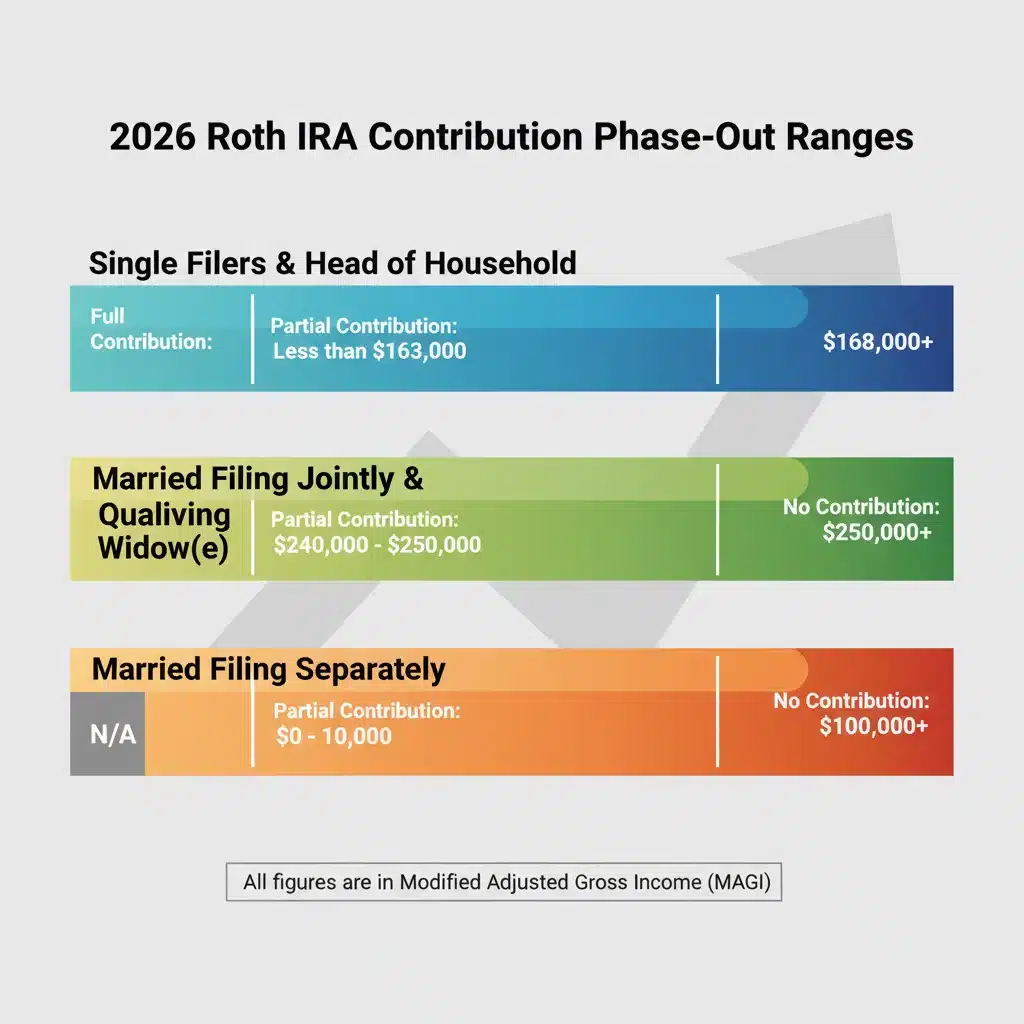
For 2026, we can expect the income phase-out ranges to increase slightly from 2025 figures. Let’s look at the projected ranges:
- Single Filers, Head of Household, or Married Filing Separately (and did not live with spouse at any time during the year): For 2025, the MAGI phase-out typically begins around $146,000 and is completely phased out at $161,000. For 2026, these figures are expected to be slightly higher, perhaps starting around $150,000 and fully phasing out around $165,000. If your MAGI falls within this range, your allowable direct Roth IRA contribution will be reduced. If it exceeds the upper limit, you cannot contribute directly.
- Married Filing Jointly or Qualifying Widow(er): For 2025, the MAGI phase-out typically begins around $230,000 and is completely phased out at $240,000. For 2026, these figures are also expected to increase, potentially starting around $235,000 and fully phasing out around $245,000. Similarly, if your joint MAGI is within this range, your direct Roth IRA 2026 contribution will be limited; if it exceeds the upper limit, direct contributions are not permitted.
It’s important to accurately calculate your MAGI to determine your eligibility. This calculation can be complex, involving various income sources and deductions. If you find your income approaching or exceeding these limits, don’t despair; the backdoor Roth IRA strategy might be your solution.
The Backdoor Roth IRA Strategy for 2026: A High-Income Earner’s Best Friend
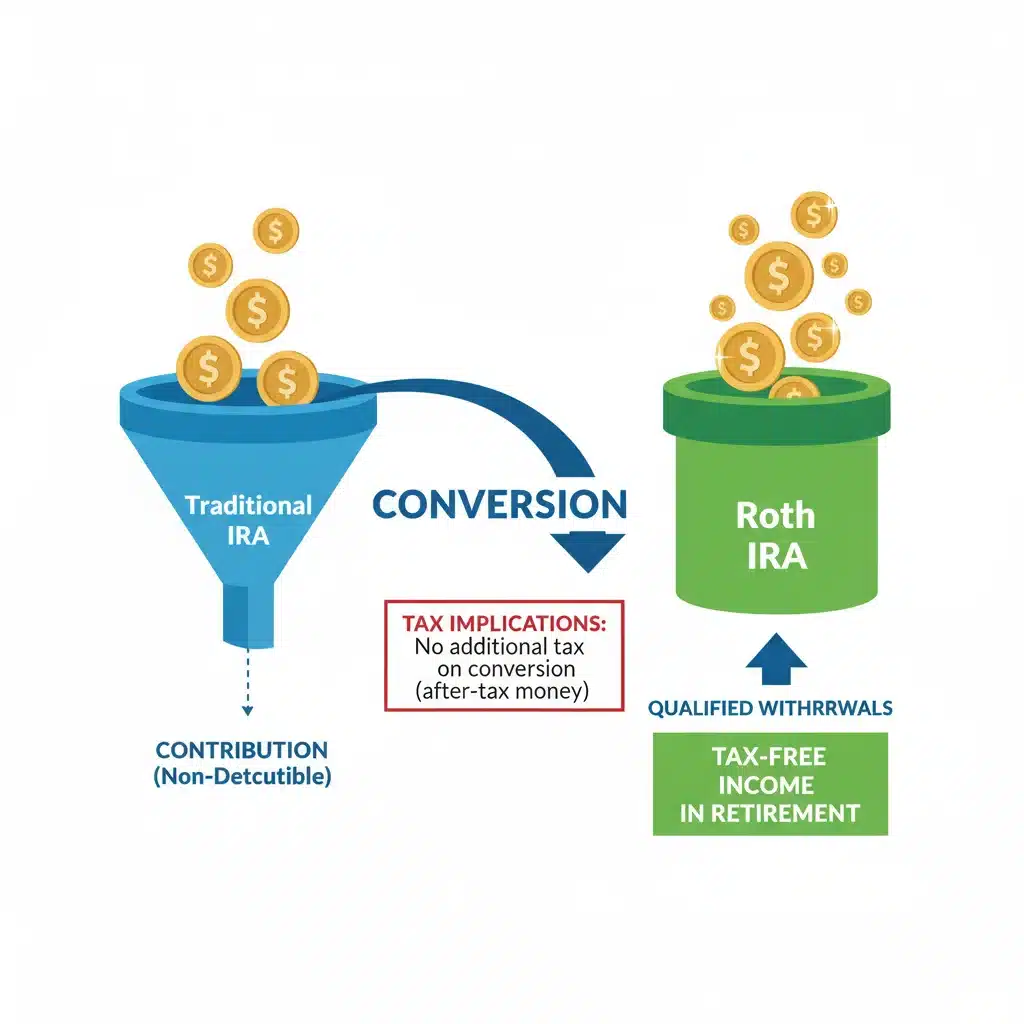
For individuals whose income exceeds the direct Roth IRA contribution limits, the backdoor Roth IRA strategy offers a legal and effective way to fund a Roth account. This strategy has gained significant popularity over the years and is expected to remain a viable option for the Roth IRA 2026. The process typically involves two main steps:
- Contribute to a Non-Deductible Traditional IRA: First, you contribute to a traditional IRA. Since your income is too high to deduct traditional IRA contributions, this contribution is made with after-tax dollars. You can contribute up to the maximum annual limit (e.g., projected $7,000-$7,500 for under 50, or $8,000-$8,500 for 50 and over in 2026).
- Convert the Traditional IRA to a Roth IRA: Shortly after making the non-deductible contribution, you convert that traditional IRA money into a Roth IRA. Since the original contribution was made with after-tax dollars, this conversion is typically a non-taxable event, or at least minimally taxable if there were any earnings in the traditional IRA before conversion.
This two-step process effectively bypasses the income limitations for direct Roth contributions, allowing high-income earners to still benefit from the tax-free growth and withdrawals of a Roth IRA 2026. It’s crucial to execute this strategy correctly to avoid unintended tax consequences, particularly the ‘pro-rata rule.’
Understanding the Pro-Rata Rule and Aggregation for Backdoor Roth
The pro-rata rule is a critical consideration for anyone employing the backdoor Roth strategy, especially if you hold other traditional IRA accounts (including SEP IRAs or SIMPLE IRAs). The IRS views all your traditional IRA accounts as one for tax purposes when you do a Roth conversion. If you have pre-tax money in any traditional IRA, a portion of your conversion will be taxable, even if you only convert the non-deductible contribution you just made.
For example, if you have $93,000 in pre-tax traditional IRA money and contribute $7,000 non-deductibly, your total traditional IRA balance is $100,000. If you then convert the $7,000, 93% ($93,000 / $100,000) of that conversion will be taxable, and only 7% ($7,000 / $100,000) will be tax-free. This significantly diminishes the benefit of the backdoor Roth. To avoid the pro-rata rule, ideally, you should have no pre-tax money in any traditional IRA accounts when you perform the conversion. If you do, consider rolling these pre-tax IRA funds into your current employer’s 401(k) or 403(b) plan, if your plan allows, before executing the backdoor Roth. This effectively clears out your traditional IRA balance, allowing for a truly tax-free conversion of your non-deductible contribution.
Given the complexities, it is highly recommended to consult with a tax professional or financial advisor when implementing a backdoor Roth strategy for your Roth IRA 2026 contributions to ensure compliance and optimize tax efficiency.
Who Should Consider a Roth IRA in 2026?
A Roth IRA 2026 can be an excellent choice for a variety of individuals, each with unique financial circumstances. Here are some profiles that typically benefit most:
- Young Professionals: If you are early in your career and expect your income to grow significantly over time, a Roth IRA is a fantastic choice. You pay taxes now, likely at a lower rate, and enjoy tax-free withdrawals when you’re potentially in a much higher tax bracket during retirement.
- Individuals Expecting Higher Taxes in Retirement: This is the core appeal of the Roth IRA. If you believe tax rates will be higher in the future, or if your income in retirement will be substantial (perhaps from other investments or pensions), locking in tax-free income now is a smart move.
- People Who Value Tax-Free Growth: The magic of compounding tax-free growth over decades can lead to a substantial sum that is entirely yours, without future tax liabilities.
- Those Seeking Flexibility: The ability to withdraw contributions without tax or penalty before retirement offers a unique safety net, although it’s always best to keep retirement funds dedicated to retirement. Also, no RMDs for the original owner provides greater control over your retirement income.
- High-Income Earners (via Backdoor Roth): As discussed, even if your income exceeds the direct contribution limits, the backdoor Roth strategy allows you to access these benefits, making the Roth IRA 2026 relevant for nearly all income levels.
Conversely, if you are currently in a very high tax bracket and expect to be in a lower one in retirement, a traditional IRA (with deductible contributions) might offer more immediate tax benefits. However, for most, the long-term advantages of a Roth IRA are compelling.
Maximizing Your Roth IRA 2026 Contributions: Practical Tips
Once you understand the rules and benefits, the next step is to ensure you are maximizing your contributions to the Roth IRA 2026. Here are some practical tips:
- Contribute Early and Regularly: The power of compound interest is amplified when you start early. Contributing at the beginning of the year, or setting up automatic monthly contributions, ensures your money has the maximum time to grow tax-free. Don’t wait until the tax deadline to fund your Roth IRA.
- Aim for the Maximum: Try to contribute the full annual limit (e.g., projected $7,000-$7,500, or $8,000-$8,500 if 50+) if your financial situation allows. Every dollar contributed now is a dollar that can grow tax-free for decades.
- Review Your MAGI Annually: Your modified adjusted gross income can fluctuate. Regularly review your MAGI to ensure you are still eligible for direct contributions or if you need to consider the backdoor Roth strategy. Tax planning throughout the year can help you manage your income for optimal Roth IRA eligibility.
- Consult a Financial Advisor: Especially if your financial situation is complex, or if you plan to use the backdoor Roth strategy, a qualified financial advisor can provide personalized guidance. They can help you navigate the rules, understand the pro-rata rule, and integrate your Roth IRA into your broader financial plan.
- Consider Other Retirement Vehicles: While the Roth IRA 2026 is excellent, it’s often part of a larger retirement strategy. Don’t forget to also maximize employer-sponsored plans like 401(k)s, especially if they offer matching contributions. A diversified approach to retirement savings can provide greater security.
- Educate Yourself Continuously: Tax laws and retirement rules can change. Stay informed by reading reputable financial news sources, IRS publications, and consulting professionals. The more knowledgeable you are, the better equipped you will be to make sound financial decisions.
Common Misconceptions About Roth IRAs
Despite their popularity, several misconceptions about Roth IRAs persist. Clarifying these can help you better utilize your Roth IRA 2026:
- Myth: You can’t contribute to a Roth IRA if you have a 401(k).
Fact: You can contribute to both a 401(k) (or 403(b), etc.) and a Roth IRA simultaneously. These are separate retirement vehicles with independent contribution limits. In fact, for many, contributing to both is an excellent strategy for tax diversification in retirement. - Myth: You can’t contribute to a Roth IRA if your income is too high.
Fact: While direct contributions have income limits, the backdoor Roth IRA strategy allows high-income earners to bypass these limits and still fund a Roth account. - Myth: Roth IRAs are only for young people.
Fact: While young people benefit greatly from the long compounding period, Roth IRAs can be valuable at any age. Even individuals nearing retirement can benefit from tax-free growth and withdrawals, especially if they anticipate higher tax rates later or want to leave tax-free assets to heirs. The catch-up contribution for those 50 and older further enhances its appeal. - Myth: Contributions to a Roth IRA are tax-deductible.
Fact: This is a key distinction from traditional IRAs. Roth IRA contributions are made with after-tax dollars and are not tax-deductible. The tax benefit comes at withdrawal in retirement. - Myth: You have to choose between a Roth IRA and a Roth 401(k).
Fact: You can have both! A Roth 401(k) is an employer-sponsored plan with higher contribution limits, while a Roth IRA is an individual retirement account. Both offer tax-free withdrawals in retirement and can be powerful tools when used together.
Dispelling these myths is crucial for making informed decisions about your Roth IRA 2026 and overall retirement planning.
The Role of Roth IRAs in a Holistic Retirement Plan
While this article focuses on the Roth IRA 2026, it’s essential to view it as one component of a broader, holistic retirement strategy. A well-rounded retirement plan often includes a mix of different account types to provide tax diversification and flexibility:
- Employer-Sponsored Plans (401(k), 403(b), etc.): These are often the cornerstone of retirement savings, especially if your employer offers matching contributions. Maximize these contributions, at least up to the match, as it’s essentially free money. Consider the Roth 401(k) option if available, for additional tax diversification.
- Traditional IRAs: If you’re eligible for deductible contributions, or if you need a vehicle for the backdoor Roth strategy, a traditional IRA plays an important role.
- Health Savings Accounts (HSAs): For those with high-deductible health plans, HSAs offer a triple tax advantage: tax-deductible contributions, tax-free growth, and tax-free withdrawals for qualified medical expenses. They can act as a stealth retirement account.
- Taxable Brokerage Accounts: For savings beyond retirement account limits, or for funds you might need before retirement age, a taxable brokerage account provides liquidity and investment growth, though subject to capital gains taxes.
By strategically utilizing a combination of these accounts, including your Roth IRA 2026, you can create a robust retirement portfolio that is resilient to future tax changes and provides the flexibility you need in your golden years. Regular review and adjustment of your plan with a financial professional are crucial to ensure it remains aligned with your goals and evolving circumstances.
Conclusion: Secure Your Future with Roth IRA 2026
The Roth IRA 2026 continues to be an indispensable tool for retirement savings, offering unparalleled tax benefits through its tax-free withdrawals in retirement. Understanding the projected contribution limits, navigating the income phase-outs, and mastering strategies like the backdoor Roth are essential steps for anyone looking to optimize their long-term financial health. Whether you’re a young professional just starting your savings journey or a high-income earner seeking to maximize tax-advantaged growth, the Roth IRA offers a clear path to a more secure and prosperous retirement.
As the financial landscape shifts, staying informed and proactive is key. While the official 2026 figures will be released later, the principles and strategies discussed here provide a solid foundation for your planning. Don’t underestimate the power of starting early, contributing consistently, and seeking professional advice to ensure your Roth IRA 2026 contributions are perfectly aligned with your broader financial goals. By taking these steps, you can confidently build a future where your retirement income is truly your own, free from the burden of taxes.