Navigating 2026 FAFSA Changes: Your Ultimate Guide to Maximizing Federal Student Aid

The landscape of federal student aid is constantly evolving, and for families planning for college in the coming years, understanding the significant 2026 FAFSA changes is paramount. The Free Application for Federal Student Aid (FAFSA) is the gateway to billions of dollars in grants, scholarships, work-study programs, and federal student loans. However, the form and its underlying methodology have undergone a substantial overhaul, with many of these changes fully taking effect for the 2024-2025 aid year and subsequent years, including the crucial 2026-2027 cycle. This comprehensive guide will dissect the 2026 FAFSA changes, providing you with the knowledge and strategies needed to navigate the new system and maximize your family’s federal student aid.
Understanding the FAFSA Simplification Act and Its Impact
The FAFSA Simplification Act, passed in 2020, represents the most significant redesign of the federal student aid application process in decades. While some provisions were implemented incrementally, the full impact of these changes will be felt keenly in the 2024-2025 FAFSA cycle and beyond, directly influencing the 2026-2027 aid year. The primary goals of this act were to streamline the application process, expand eligibility for federal student aid, and provide a more accurate assessment of a family’s financial need. These 2026 FAFSA changes are designed to make college more accessible and affordable for a wider range of students.
Key Changes to the FAFSA Form
One of the most noticeable 2026 FAFSA changes is the reduction in the number of questions. The form has been significantly shortened, aiming to make it less intimidating and quicker to complete. What was once a daunting task for many families is now intended to be a more user-friendly experience. This simplification is a welcome relief, but it doesn’t mean the underlying calculations are less complex. In fact, understanding the new terminology and methodologies is more important than ever.
The Shift from EFC to SAI: Student Aid Index Explained
Perhaps the most critical of the 2026 FAFSA changes is the replacement of the Expected Family Contribution (EFC) with the Student Aid Index (SAI). The EFC was a widely misunderstood term, often interpreted as the amount a family would actually pay for college. The SAI is intended to be a clearer indicator of a student’s eligibility for federal student aid, ranging from -1500 to a high positive number. A negative SAI indicates a higher level of financial need, potentially leading to increased Pell Grant eligibility. This shift is not merely semantic; it reflects a fundamental change in how financial need is calculated and how aid is distributed.
Expanded Pell Grant Eligibility
The FAFSA Simplification Act also expands Pell Grant eligibility, a crucial aspect of the 2026 FAFSA changes. More students from low-income backgrounds will qualify for Pell Grants, and some may receive a higher amount. The new methodology simplifies the determination of Pell Grant eligibility by linking it directly to a student’s SAI and the federal poverty levels. This expansion is a significant step towards making higher education more attainable for financially disadvantaged students, representing a core objective of the overall 2026 FAFSA changes.
Decoding the New Methodologies: What’s Different?
The 2026 FAFSA changes involve more than just a new name for the EFC. The underlying formulas and considerations for calculating financial need have been revised. These changes will impact how different types of income and assets are treated, potentially altering aid eligibility for many families. Being aware of these methodological shifts is crucial for effective financial planning.
Income Assessment: A Closer Look
One of the most significant 2026 FAFSA changes relates to how income is assessed. The new FAFSA will primarily rely on prior-prior year tax data, as it has in recent years, but the way certain income components are factored in has changed. For example, untaxed income, such as child support received, will now be included in the income calculation for the SAI. Conversely, federal tax benefits, like the Earned Income Tax Credit, will no longer be counted as untaxed income, which could positively impact some families’ aid eligibility. Understanding these nuances is key to accurately predicting your SAI.
Asset Assessment: What Counts and What Doesn’t
The treatment of assets has also seen notable 2026 FAFSA changes. Perhaps the most impactful is the exclusion of family farms and small businesses with 100 or fewer full-time employees from asset calculations, provided they are owned and operated by the family. This is a significant relief for many families who previously saw their aid eligibility reduced due to these assets. Additionally, the FAFSA will continue to exclude the value of the family’s primary residence. However, other assets, such as savings accounts, investments, and 529 plans (owned by the student or parent), will still be considered. Knowing which assets are assessed and which are not is vital for families preparing for the 2026 FAFSA changes.
Impact of Siblings in College: A Major Shift
Historically, having multiple children enrolled in college simultaneously significantly reduced the EFC per student, as the EFC was divided among them. This provision has been eliminated under the FAFSA Simplification Act. This is one of the most controversial 2026 FAFSA changes, as it means families with multiple children in college at the same time may see a substantial decrease in their federal aid eligibility per student. Families in this situation will need to re-evaluate their financial planning strategies and explore other avenues for aid, such as institutional scholarships or private loans. This change underscores the importance of proactive planning in light of the 2026 FAFSA changes.

Strategies for Maximizing Federal Student Aid Under the New System
While the 2026 FAFSA changes introduce new complexities, they also present opportunities for savvy families to optimize their financial aid potential. Strategic planning and a thorough understanding of the new rules are essential.
Early Planning is More Crucial Than Ever
With the 2026 FAFSA changes, early planning is no longer just a recommendation; it’s a necessity. Families should begin researching and understanding the new FAFSA methodology well before their student enters their junior year of high school. This allows time to make informed decisions about income and asset management that could positively impact their SAI. Proactive engagement with the 2026 FAFSA changes will put you in a stronger position.
Understanding the Direct Data Exchange with the IRS
A significant improvement under the FAFSA Simplification Act is the direct data exchange with the IRS. This means most applicants will no longer manually enter their tax information. Instead, the FAFSA will securely retrieve tax data directly from the IRS using the Future Act Direct Data Exchange (FADDX). This streamlines the process, reduces errors, and improves data accuracy. While this simplifies the application, it also means that the tax information used will be precisely what was filed with the IRS for the prior-prior year. Families need to ensure their tax filings are accurate and reflect their financial situation appropriately, as these figures will directly feed into the SAI calculation under the 2026 FAFSA changes.
Strategic Asset Management
Given the new asset assessment rules, families should review their financial portfolios. While the primary residence, family farms, and small businesses are now excluded, other assets still count. Consider consulting with a financial advisor to understand how your current asset allocation might impact your SAI. For instance, if you have significant funds in taxable investment accounts, exploring options like 529 plans (which are considered parent assets and have a more favorable treatment than student-owned assets) could be beneficial. Understanding these nuances of the 2026 FAFSA changes can lead to significant savings.
Income Management Considerations
For families with fluctuating incomes, understanding how prior-prior year income impacts the SAI is critical. If there’s a significant drop in income due to job loss, illness, or other circumstances, families can appeal to the financial aid office at their chosen college for a professional judgment review. This allows colleges to use current year income information to adjust the SAI. Being aware of this option is vital, especially when navigating the 2026 FAFSA changes during periods of financial instability.
Exploring Other Aid Sources
While federal aid is foundational, it’s not the only source of financial assistance. With the 2026 FAFSA changes, and especially the elimination of the sibling discount, families may need to place a greater emphasis on other aid opportunities. This includes:
- Institutional Aid: Many colleges offer their own grants and scholarships based on both need and merit. These often require separate applications.
- State Aid: Most states have their own financial aid programs for residents. Check your state’s higher education agency for details.
- Private Scholarships: Countless organizations, foundations, and businesses offer scholarships. Students should actively search and apply for these throughout their high school years.
- Work-Study Programs: Federal Work-Study allows students to earn money through part-time jobs on campus or with non-profit organizations.
Diversifying your aid search is a smart strategy in light of the 2026 FAFSA changes.
Who Benefits and Who Might Be Negatively Impacted by the Changes?
The 2026 FAFSA changes are designed to broaden access to federal student aid, but like any large-scale reform, there will be beneficiaries and those who might find themselves in a less advantageous position. Understanding these shifts can help families prepare.
Beneficiaries of the New FAFSA
- Low-Income Families: The expanded Pell Grant eligibility and the potential for a negative SAI will significantly benefit students from the lowest-income households, making college more affordable.
- Single-Parent Households: Changes in how household size is determined and the removal of the requirement for the custodial parent to be the one who provides the most financial support could benefit some single-parent families.
- Families with Small Businesses or Farms: The exclusion of these assets from the SAI calculation is a major win for these families, potentially increasing their aid eligibility.
- Students whose parents are divorced or separated: The FAFSA will now require the parent who provides the most financial support to the student to complete the form, regardless of which parent the student lived with most recently. This aligns with the tax definition of who claims the child and can simplify the process for some families while potentially shifting aid eligibility for others.
These groups are likely to see a positive impact from the 2026 FAFSA changes.
Potentially Negatively Impacted Groups
- Families with Multiple Children in College: As mentioned, the elimination of the discount for having siblings concurrently enrolled in college is a significant drawback for these families, who may see their overall aid package reduced. This is arguably the most impactful of the 2026 FAFSA changes for middle- and upper-middle-income families.
- Some Middle-Income Families: While the goal is to expand aid, some middle-income families who previously qualified for need-based aid due to specific circumstances (like high medical expenses not fully covered by insurance, which are no longer considered) might find their SAI higher than their previous EFC.
- Students with Significant Untaxed Income: While not a large group, students or families receiving substantial untaxed income (like certain benefits not previously counted) might see their SAI increase.
It’s crucial for all families to re-evaluate their expected aid based on the 2026 FAFSA changes, rather than relying on past experiences.
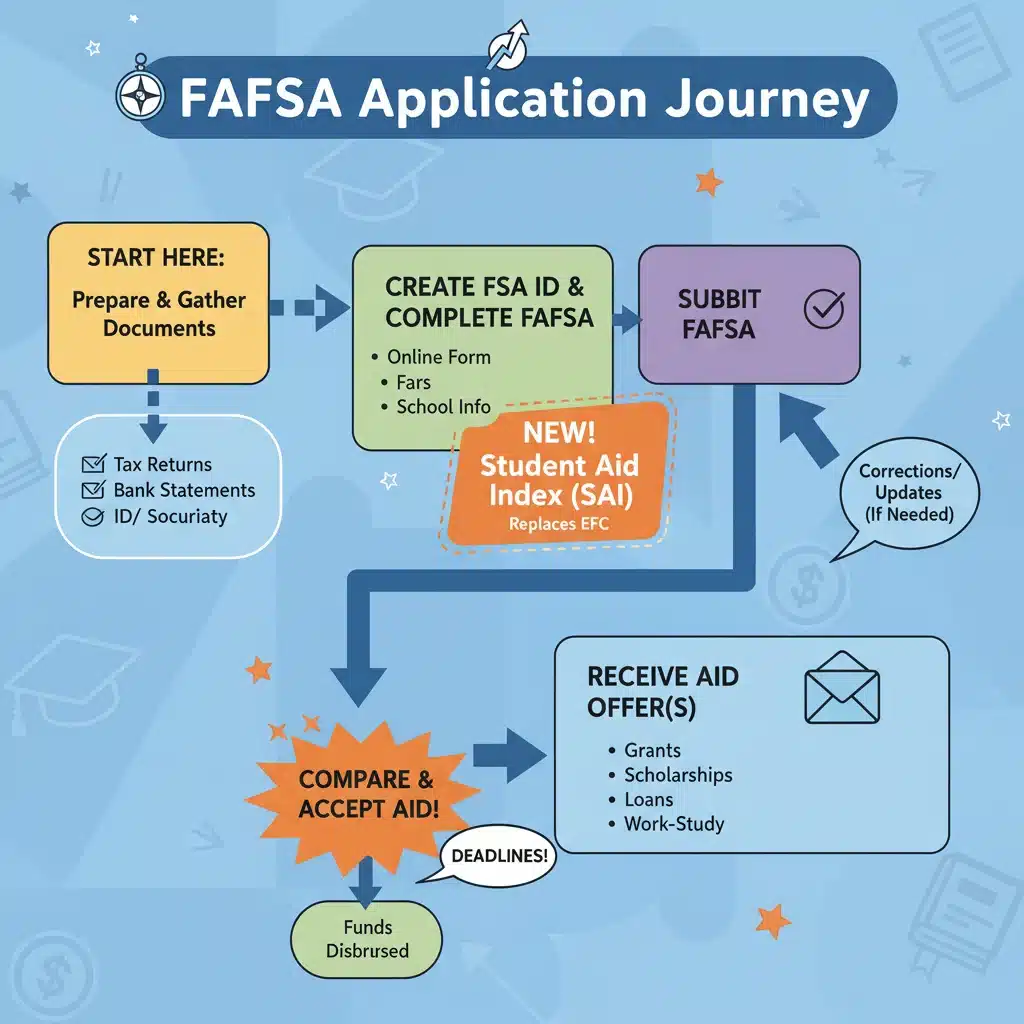
Preparing for the 2026-2027 FAFSA Cycle: A Checklist
To successfully navigate the 2026 FAFSA changes and maximize your federal student aid, follow this proactive checklist:
- Understand Your ‘Prior-Prior Year’ Data: The 2026-2027 FAFSA will use your 2024 tax information. Begin gathering and organizing these documents now. Ensure your 2024 tax returns are filed accurately and on time.
- Create an FSA ID: Both the student and one parent (if applicable) will need an FSA ID to access and sign the FAFSA electronically. Create these well in advance, as it can take a few days for them to become active.
- Review Your Assets: Understand which assets will be counted towards your SAI and which will not. Consider strategic adjustments if appropriate and within your financial planning goals.
- Estimate Your SAI: Utilize online FAFSA estimators that have been updated to reflect the new SAI methodology. This can give you a preliminary idea of your aid eligibility.
- Research Institutional Aid Deadlines: While the FAFSA is federal, many colleges have their own financial aid applications and deadlines. Keep track of these dates.
- Communicate with Financial Aid Offices: If you anticipate unusual circumstances (e.g., significant income reduction, high medical expenses), be prepared to discuss these with college financial aid offices for a professional judgment review.
- Stay Informed: The Department of Education and various financial aid organizations frequently update their guidance on the 2026 FAFSA changes. Regularly check official sources for the latest information.
- Seek Professional Advice: Consider consulting with a financial aid advisor or college planning expert who is knowledgeable about the new FAFSA rules.
The Importance of the FAFSA in the Broader College Funding Picture
Despite the 2026 FAFSA changes, the FAFSA remains the cornerstone of college financial aid. It’s not just for federal grants and loans; most state and institutional need-based aid also relies on the information provided in the FAFSA. Even if you believe your family won’t qualify for federal grants, completing the FAFSA is often a prerequisite for many scholarships and institutional aid programs. Therefore, understanding and accurately completing the FAFSA is a non-negotiable step in funding higher education.
The new FAFSA aims for greater equity and simplicity, but the transition period requires vigilance and proactive engagement from families. By understanding the 2026 FAFSA changes, families can better strategize their financial planning, explore all available aid avenues, and ultimately make informed decisions about their educational investments. The journey to higher education can be costly, but with careful preparation and a solid grasp of the evolving financial aid landscape, it can also be an achievable dream for many.
Remember, the goal is not just to fill out the form, but to understand the implications of each question and how it contributes to your Student Aid Index. This knowledge empowers you to advocate for your student and secure the best possible financial aid package. The 2026 FAFSA changes are significant, but with the right approach, your family can successfully navigate them and unlock valuable educational opportunities.
Further Resources for FAFSA Updates:
- Federal Student Aid Official Website
- National Association of Student Financial Aid Administrators (NASFAA)
- Your college’s financial aid office
Stay informed, plan ahead, and good luck with your college financial aid journey!